How Long to Smoke a Spatchcock Turkey: A Complete Timing Guide
Every November, home cooks face the same nagging question the night before a big meal: how long does a spatchcock turkey actually need on the smoker? Unlike a whole roasted bird, a spatchcocked turkey behaves differently on a smoker, and getting the timing wrong can mean a dry breast or an undercooked thigh. This guide walks through exactly how long to smoke a spatchcock turkey, what affects that timing, and how to make sure your bird comes out juicy, evenly cooked, and ready well before your guests start asking when dinner is served.
We’ll cover the general time ranges you can expect at different smoker temperatures, the factors that speed up or slow down cooking, step-by-step guidance for getting it right, and the mistakes that trip up even experienced grillers. By the end, you’ll have a clear framework for planning your smoke day with confidence.
What Does Spatchcocking Actually Do to Cook Time?
Spatchcocking means removing the backbone and flattening the turkey so it lies flat on the grate. This single change dramatically reshapes how heat moves through the bird. Instead of hot air having to circulate around a dense, curled shape, it now flows evenly across a flat surface, cooking the breast and thighs at closer to the same rate. That’s the whole point of the technique: more consistent doneness, less guessing.
The practical result is speed. A spatchcocked turkey typically cooks 30 to 40 percent faster than a whole, trussed bird at the same temperature. A 14-pound whole turkey might take five or six hours in a smoker, while the same bird spatchcocked could be done in three to three and a half hours. That time savings matters when you’re managing a holiday schedule, but it also means the margin for error shrinks. A flatter bird gets hot faster, so it’s easier to overshoot doneness if you’re not checking temperature regularly.
How Long to Smoke a Spatchcock Turkey at Different Temperatures
Smoker temperature is the single biggest variable in your timing. Similar smoking methods for other meats are also used for other meats, where temperature control and cooking duration play an important role in achieving the right texture and flavor. At 225°F, a low-and-slow approach, expect roughly 30 minutes per pound, putting a 12 to 14 pound turkey in the range of six to seven hours. This produces excellent smoke flavor but requires patience and a smoker that holds steady heat for a long stretch.
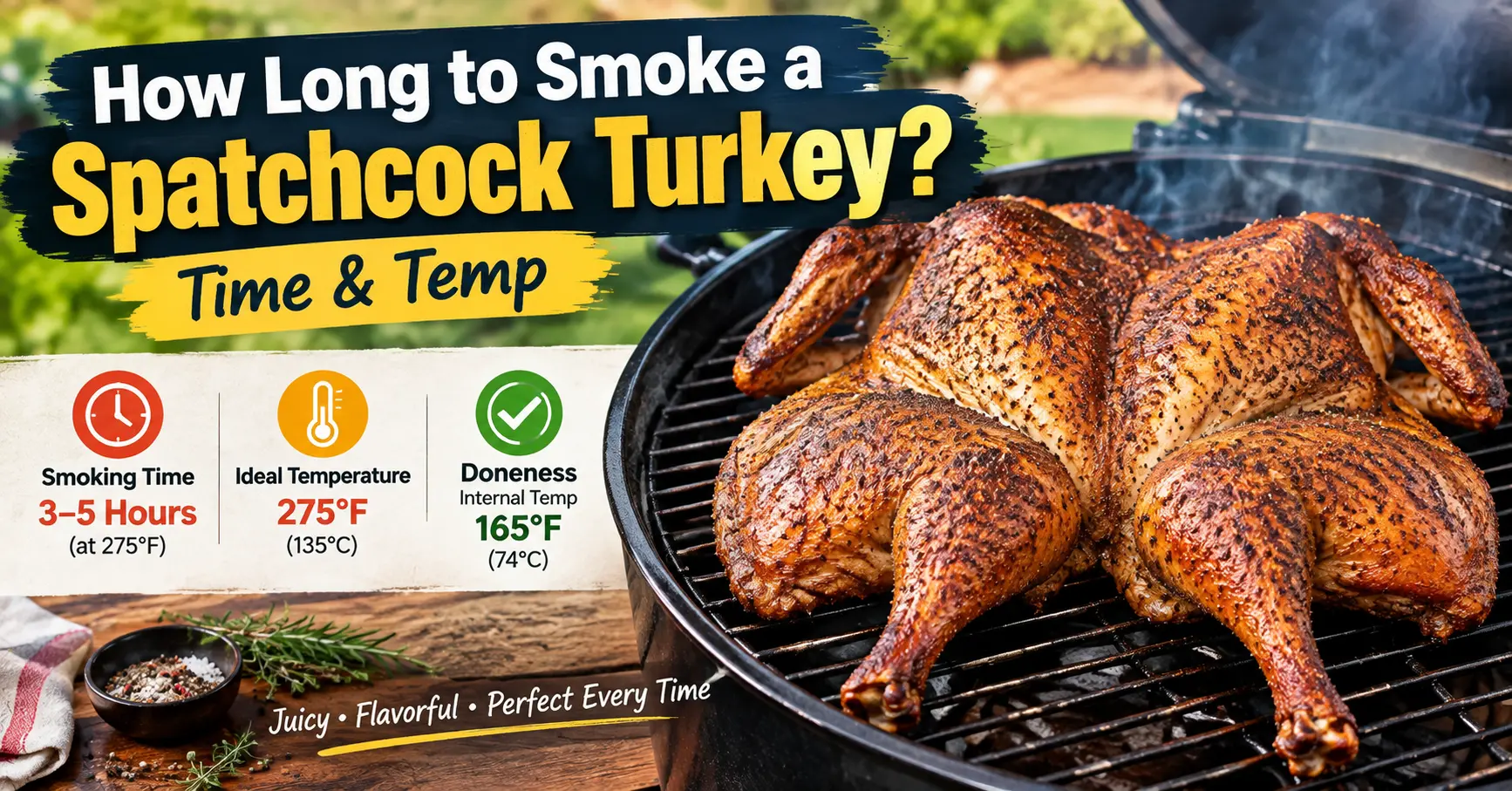
At 275°F, a more common middle-ground setting, plan on about 20 to 25 minutes per pound. That same 12 to 14 pound bird finishes in roughly three and a half to four hours, a good balance between smoke penetration and a manageable cook time. Pushing the smoker to 325°F or 350°F shortens things further, to around 12 to 15 minutes per pound, meaning the bird could be done in two to two and a half hours. Higher heat sacrifices some smoky depth but crisps the skin better, which many cooks find worth the trade-off. Whichever range you choose, these numbers are starting points, not guarantees, since every smoker and every bird behaves a little differently.
Key Factors That Change Your Actual Cook Time
Turkey weight is the obvious factor, but it interacts with shape in a way people often miss. A wider, flatter bird after spatchcocking cooks faster per pound than a narrower one, since more surface area is exposed directly to heat. Two 13-pound turkeys spatchcocked by different people, with different amounts of flattening, can finish at meaningfully different times.
Ambient temperature and wind play a bigger role outdoors than most people expect. Smoking in 40°F weather with a stiff breeze forces your smoker to work harder to hold its set temperature, which can add 20 to 30 minutes to your total cook time. Opening the lid frequently to check on the bird has a similar effect, since every peek lets heat escape and resets the recovery clock. Finally, whether the turkey started fully thawed matters enormously; even a partially frozen bird near the thigh joint will cook unevenly and take considerably longer to reach a safe internal temperature throughout.
How to Check for Doneness the Right Way
Time estimates are only ever a starting point, not the finish line. The only reliable way to know a spatchcock turkey is done is with an instant-read meat thermometer, checked in multiple spots. The thickest part of the breast should read 165°F, while the thigh, closer to the bone, should reach at least 175°F for the best texture, since dark meat benefits from a slightly higher temperature to break down connective tissue properly.
Check both sides of the bird, since heat distribution across a grate is rarely perfectly even, and smokers often run hotter on one side than the other. It’s worth checking temperature starting around the two-hour mark for a mid-temperature smoke, then every 20 to 30 minutes after that, rather than waiting until the estimated time is nearly up. This gives you a real-time read on how the bird is progressing and avoids the surprise of pulling it early only to find the thigh isn’t there yet.
Common Mistakes That Throw Off Your Timing
One of the most frequent errors is not accounting for carryover cooking. A turkey’s internal temperature continues climbing for several minutes after it comes off the heat, sometimes by five degrees or more, so pulling it exactly at 165°F in the breast can actually push it slightly past that mark during rest. Planning to pull a few degrees early accounts for this and helps prevent dry meat.
Another common misstep is skipping the rest period entirely in the rush to carve and serve. Turkey needs at least 15 to 20 minutes resting under loose foil before slicing, which allows juices to redistribute through the meat rather than spilling out onto the cutting board. Cooks also frequently underestimate how much a cold smoker start affects total time; throwing a turkey on a smoker that hasn’t fully preheated and stabilized adds unpredictable extra minutes right at the beginning, throwing off every estimate that follows.
Tips for a Better, More Predictable Smoke
Dry-brining the turkey a day ahead, using salt rubbed under and over the skin, helps the meat hold moisture through the faster cook that spatchcocking produces. Preparing ingredients correctly before cooking is an important part of getting consistent results, whether you are smoking a turkey or making other homemade dishes. It also seasons the bird more evenly than brining in liquid, without adding water weight that can slow searing and skin crisping.
Using a leave-in probe thermometer, rather than repeatedly opening the lid with an instant-read model, keeps your smoker’s temperature more stable throughout the cook. Every time the lid opens, heat escapes and the smoker has to work to recover, which compounds over a multi-hour cook. Positioning the thicker parts of the bird, like the thighs, toward the hotter zones of the smoker and the breast toward a slightly cooler zone can also help everything finish closer to the same time, since dark meat naturally needs a higher final temperature than white meat.
Conclusion
Smoking a spatchcock turkey rewards preparation more than precise math. While the time ranges here, roughly three to four hours at common smoker temperatures, give you a solid framework for planning your day, the thermometer in your hand is always the final word on doneness. Pay attention to the variables that shift your specific cook, from weather to bird shape to how consistently your smoker holds heat, and build in a buffer so an unexpectedly slow stretch doesn’t derail your meal. With a thawed bird, a stable smoker, and a plan to check temperature early and often, a perfectly cooked spatchcock turkey is well within reach.