
How Long to Water Grass: A Complete Guide to a Healthier, Greener Lawn
Ask ten homeowners how long they water their grass and you’ll likely get ten different answers some water every day for ten minutes, others let the sprinkler run for an hour once a week, and plenty just guess and hope for the best. The truth is, watering grass isn’t about following a fixed number of minutes; it’s about understanding how much water your lawn actually needs, how your soil absorbs it, and how your climate and grass type change the equation. Get it right, and you’ll end up with a lawn that’s thick, deep-rooted, and resistant to drought and disease. Get it wrong, and you’re either wasting water on runoff or starving your grass of what it needs to thrive.
This guide breaks down exactly how long to water grass, how often to do it, and what factors from soil type to sprinkler output to seasonal changes should shape your watering routine. Whether you’re maintaining an established lawn, nursing new grass seed, or trying to recover a patchy yard, you’ll find practical, real-world guidance here rather than vague rules of thumb.
Why Watering Duration Matters More Than You Think
Most lawn problems that look like disease or pest damage actually trace back to watering habits. Shallow, frequent watering trains grass roots to stay near the surface, where they dry out fast and become vulnerable to heat stress. Deep, less frequent watering does the opposite it pushes roots downward in search of moisture, building a lawn that can handle dry spells without turning brown at the first sign of a heat wave.
Overwatering carries its own risks. Soil that stays soggy for too long starves roots of oxygen, invites fungal disease, and can actually weaken the grass even though the lawn looks lush in the short term. The goal isn’t to water as much as possible it’s to water precisely enough that the root zone gets soaked without drowning, then to let the soil dry out somewhat before the next session. That balance is what separates a lawn that merely survives from one that genuinely thrives.
How Long to Water Grass Each Session
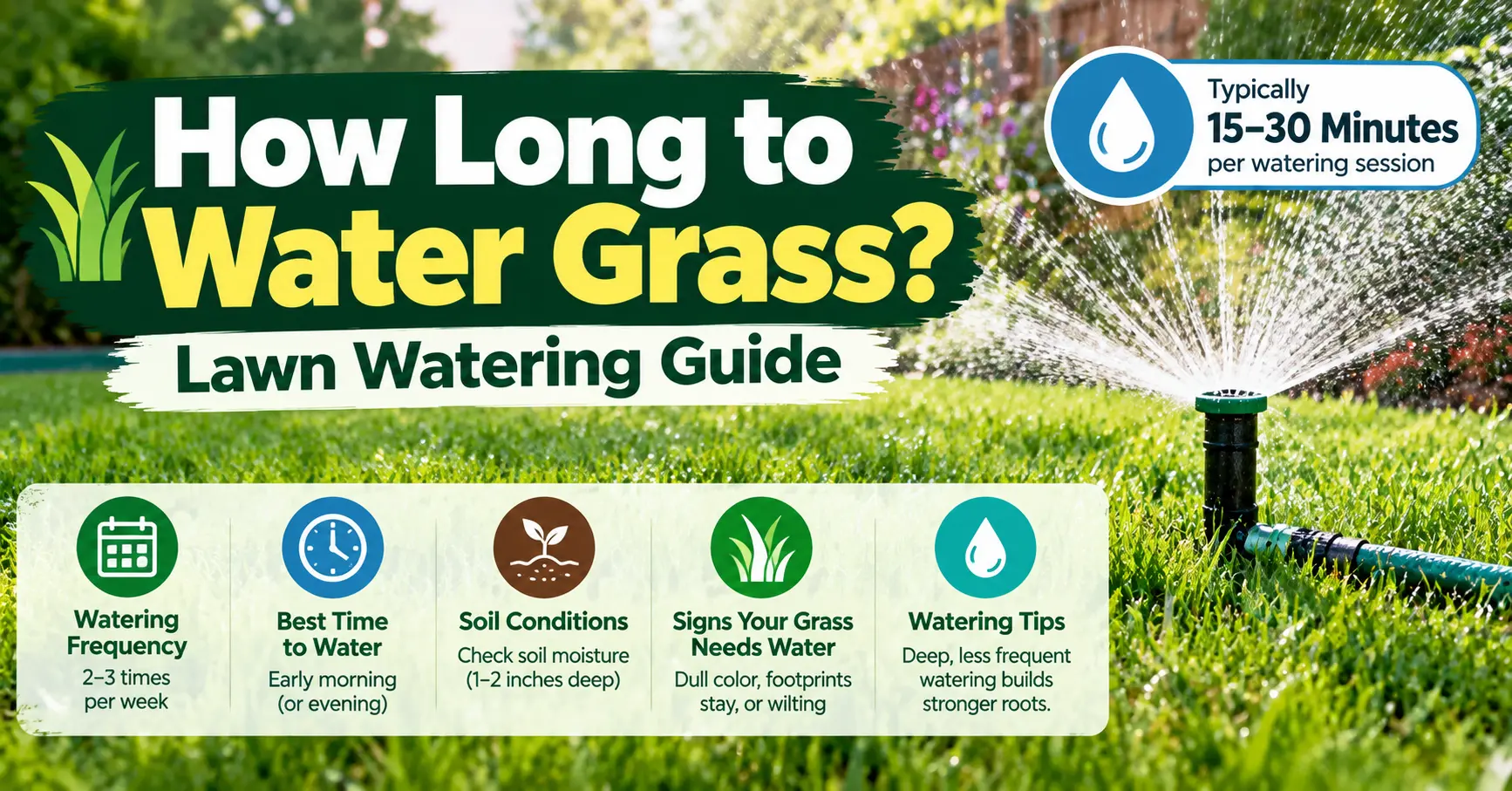
For most lawns, a single watering session should last long enough to deliver about one to one and a half inches of water to the root zone. In practical terms, that usually works out to twenty to thirty minutes per zone if you’re using a standard oscillating or rotor sprinkler, though the exact time depends heavily on your system’s output rate. Drip irrigation and soaker hoses deliver water more slowly and directly, so they often need to run longer — sometimes forty-five minutes to an hour but produce far less runoff and evaporation loss.
The simplest way to calibrate this for your own yard is the tuna can test. Place a few empty, shallow cans across your lawn while the sprinkler runs, then time how long it takes to collect about an inch of water. That number becomes your baseline. It sounds a little old-fashioned, but it’s still one of the most reliable ways to know exactly what your system is doing, since sprinkler output varies enormously between brands, water pressure, and nozzle types. Skipping this step is why so many people either overwater or underwater without realizing it.
How Often You Should Water
Duration only tells half the story frequency matters just as much. Most established lawns do best with two to three deep watering sessions per week rather than a daily light sprinkle. Watering daily in short bursts keeps only the top inch or two of soil moist, which as mentioned earlier encourages shallow roots and a lawn that struggles the moment watering stops.
New grass seed and freshly laid sod are the exception to this rule. Seedlings and fresh sod need consistent surface moisture to establish roots, so light watering once or even twice a day for the first couple of weeks is appropriate until the grass is established. Once you see new growth taking hold, you can gradually taper off toward the deeper, less frequent schedule that mature lawns prefer. Making that transition too early can stunt establishment, while delaying it too long can lead to shallow rooting right from the start.
Best Time of Day to Water Grass
Timing affects how efficiently water actually reaches the roots. Early morning, roughly between five and nine, is widely considered the best window because temperatures are cooler, winds are typically calmer, and the sun hasn’t yet ramped up evaporation. Water applied at this time has the best chance of soaking in before it’s lost to the air.
Watering in the evening is the second-best option but carries more risk, since grass that stays wet overnight is more prone to fungal issues like brown patch or dollar spot. Midday watering, meanwhile, is the least efficient choice a significant portion evaporates before it ever reaches the soil, especially in hot, dry climates. If mornings aren’t practical because of your schedule or an automated system’s timing constraints, aim as close to that early window as you reasonably can.
Factors That Change How Long You Should Water
Soil type has a bigger impact on watering duration than most people expect. Sandy soil drains quickly and holds less moisture, so it often needs shorter, more frequent watering sessions to avoid water running straight through before roots can use it. Clay soil, on the other hand, absorbs water slowly and holds onto it longer, which means watering too fast can cause runoff before the soil has a chance to soak it in a slower, split watering approach often works better here, where you water for part of the total time, pause to let it absorb, then finish the cycle.
Grass type, climate, and season all shift the equation as well. Cool-season grasses like Kentucky bluegrass or fescue generally need more consistent moisture than drought-tolerant warm-season varieties like Bermuda or zoysia, which can handle longer dry stretches between waterings. Hot, dry summer stretches naturally call for more frequent watering, while cooler spring and fall months often require far less, since evaporation slows and rainfall tends to fill in some of the gap. Paying attention to these variables, rather than sticking to a single fixed schedule year-round, is what keeps a lawn consistently healthy through changing conditions.
Signs Your Lawn Is Getting the Right Amount of Water
Grass communicates its needs fairly clearly if you know what to look for. A lawn that’s getting enough water should spring back after you walk across it footprints that linger for more than a few seconds are often an early sign of drought stress. Healthy, well-watered grass also tends to have a deep, consistent green color rather than a dull, grayish tint, which is frequently one of the first visual cues that soil moisture is running low.
Overwatering has its own telltale signs, including soil that feels spongy or waterlogged, visible fungal growth, or an unpleasant, slightly sour smell coming from the lawn. Standing water or persistent runoff into driveways and sidewalks is another clear signal to shorten your watering sessions or split them into smaller intervals. Checking soil moisture a few inches down with a screwdriver or simple probe it should slide in easily through moist soil and meet resistance in dry soil is a quick, reliable way to confirm what your lawn is telling you before problems become visible.
Common Watering Mistakes to Avoid
One of the most frequent mistakes is watering on a fixed automatic schedule without adjusting for rainfall or seasonal changes, which often leads to significant overwatering during wetter months. Rain sensors and smart irrigation controllers can help here, but even a simple habit of checking the weather before running the sprinkler makes a noticeable difference over time.
Another common issue is watering in short, frequent bursts because it feels more attentive, when in reality it does more harm than good by encouraging shallow roots. Similarly, watering the same amount uniformly across a whole yard, ignoring the different needs of sunny versus shaded areas or sloped versus flat ground, tends to leave some sections overwatered while others stay dry. Grouping sprinkler zones by sun exposure and slope, rather than treating the whole lawn identically, solves this problem and makes far better use of the water you’re already applying.
Conclusion
There’s no single magic number for how long to water grass, but there is a reliable principle behind it: water deeply, water less often, and pay attention to what your specific lawn, soil, and climate are telling you. A little observation a tuna can test here, a screwdriver soil check there goes a lot further than blindly running the sprinkler on a fixed timer. Lawns that are watered thoughtfully rather than habitually tend to reward that attention with deeper roots, richer color, and far more resilience when the weather turns tough. In the end, a great lawn isn’t the result of watering more it’s the result of watering smarter.