How Long Is Trade School? A Complete Guide to Program Length, Costs, and Career Paths
For anyone weighing their options after high school, or considering a career change later in life, one question tends to come up before almost anything else: how long is trade school actually going to take? It’s a fair question, and a practical one. Unlike a four-year degree, where the timeline is fairly standardized, trade school programs vary widely depending on the field, the school, and the credential being pursued.
This article breaks down what trade school really involves, how long different programs typically last, and what factors can shorten or extend that timeline. Whether you’re interested in becoming an electrician, a dental hygienist, a welder, or a HVAC technician, understanding the time commitment upfront can make the decision to enroll a lot less intimidating.
What Is Trade School?
Trade school, sometimes called vocational school or technical school, is a type of postsecondary education focused on teaching the practical skills needed for a specific occupation. Instead of spending years on general education requirements, students in trade programs dive straight into hands-on training related to their chosen field, whether that’s plumbing, cosmetology, automotive repair, or culinary arts.
The appeal of trade school lies in its efficiency. Programs are designed around the idea that students should graduate ready to work, not just ready to keep studying. Many trade schools partner directly with local employers, and some even build apprenticeships or job placement assistance into the curriculum. Because of this focused approach, the classroom experience tends to feel more immediately relevant, with instructors who often have real industry experience themselves.
How Long Does Trade School Typically Take?
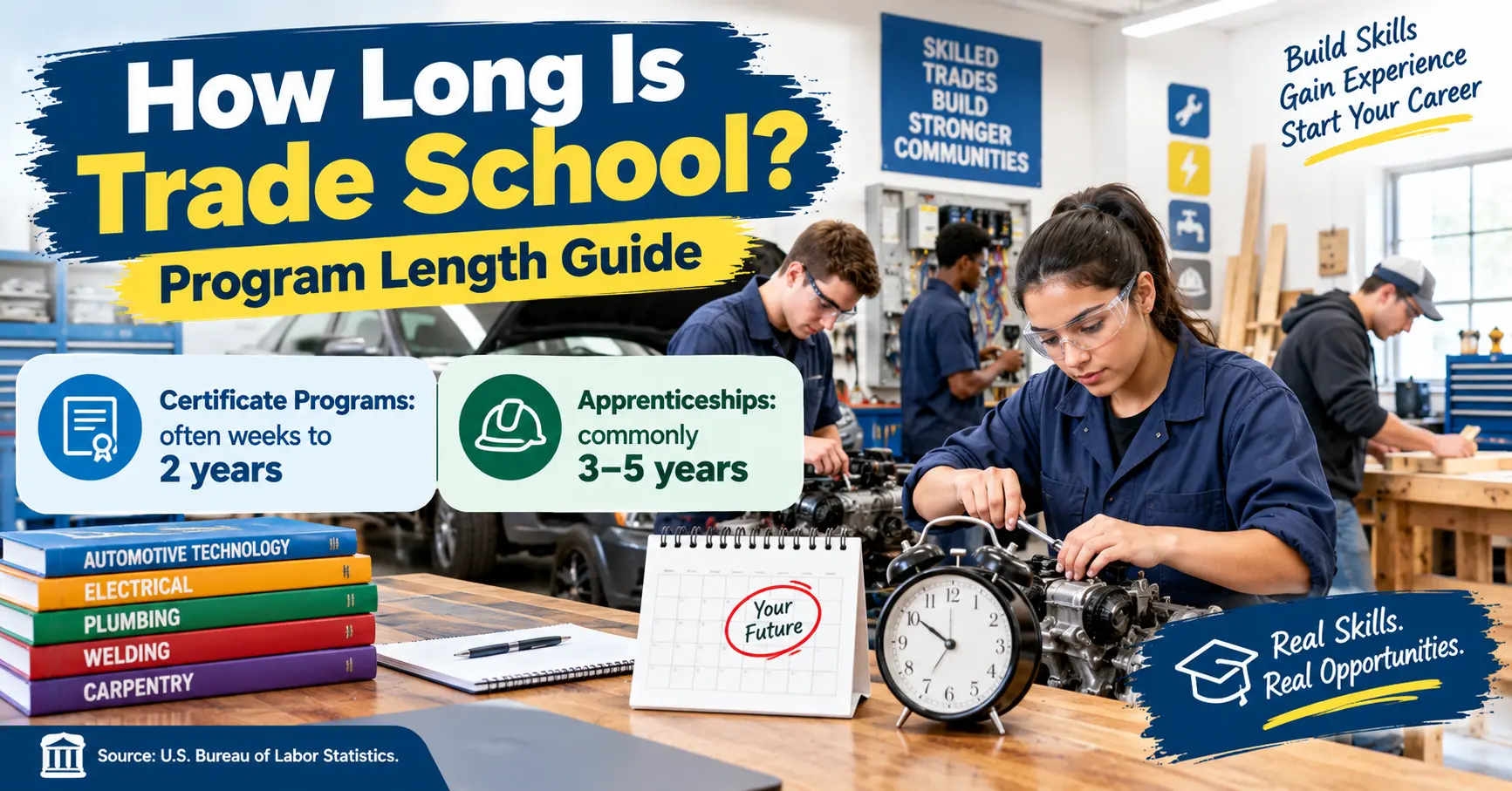
Most trade school programs fall somewhere between eight months and two years, which is considerably shorter than the four years typically required for a bachelor’s degree. Certificate programs, which are often the fastest route into a trade, can sometimes be completed in as little as a few months if attended full time.
Associate degree programs offered through community colleges or technical institutes generally take about two years, similar to any other associate degree track. These programs tend to include a bit more general coursework alongside the trade-specific training, which is part of why they run slightly longer than a standalone certificate. The exact length ultimately depends on the trade itself, the intensity of the program, and whether a student is attending full time or part time.
Program Length by Trade
Different trades come with different training requirements, and that’s reflected in how long each program takes to complete. A cosmetology program, for example, often takes around nine to fifteen months, depending on state licensing requirements. Welding certificate programs can sometimes be finished in six to nine months, though more advanced certifications may take closer to two years.
Fields that involve more technical complexity or safety considerations, such as HVAC technology or electrical work, typically require longer training periods, often between one and two years, followed by an apprenticeship that can add several more years before full licensure. Healthcare-related trade programs, like those for dental assistants or medical billing specialists, usually fall in the nine-month to one-year range, while more involved programs such as radiologic technology can take closer to two years due to the additional clinical hours required.
Factors That Affect Trade School Duration
A handful of variables can push a program’s length up or down. Enrollment status is one of the biggest factors. Someone attending full time will almost always finish faster than someone balancing part-time coursework around a job or family responsibilities. Some schools offer accelerated formats specifically designed to compress the timeline for students who can commit to a heavier course load.
State licensing requirements also play a role, particularly in fields like cosmetology, electrical work, and healthcare, where a certain number of instructional hours is mandated before a student is even eligible to sit for a licensing exam. Additionally, programs that include an apprenticeship or extensive clinical placement component will naturally take longer than those that are purely classroom or lab based, since real-world hours often need to be logged over an extended period rather than compressed into a single semester.
Trade School vs. College: A Time Comparison
One of the clearest advantages trade school offers is speed. A traditional four-year degree requires, as the name suggests, roughly four years of full-time study, plus general education courses that may have little direct connection to a student’s eventual career. Trade school programs skip much of that, concentrating almost entirely on skills tied to a specific job.
This shorter timeline doesn’t necessarily mean a lower earning ceiling. Many skilled trades, particularly those requiring licensure such as electricians or plumbers, offer strong wages that can rival or exceed entry-level salaries in fields requiring a bachelor’s degree. For students who know early on which career path interests them, trade school can mean entering the workforce years sooner, with considerably less student debt along the way.
Accelerated and Part-Time Program Options
Not every student fits the standard full-time mold, and most trade schools recognize that. Accelerated programs are built for students who want to finish as quickly as possible, often through condensed schedules, summer sessions, or back-to-back course sequences that eliminate downtime between terms. These options can sometimes shave months off a typical program length.
On the other end of the spectrum, part-time programs exist for those juggling work, family, or other commitments. While part-time study naturally extends the overall timeline, it allows students to keep earning an income or managing other responsibilities while they train. Many schools also offer evening or weekend classes specifically to accommodate working adults, which has made trade education increasingly accessible to career changers rather than just recent high school graduates.
What to Expect After Graduation
Completing a trade program is often just the first step. Many trades require passing a licensing or certification exam before a graduate can legally work in the field, and some, like electrical or plumbing work, require a period of supervised apprenticeship afterward, sometimes lasting several years, before a person can become fully licensed and work independently.
That said, the transition from classroom to career tends to happen faster in trade fields than in many other industries. Because programs are built around direct job readiness, graduates often step into entry-level positions almost immediately, sometimes through the very employer connections their school helped facilitate. This practical, employment-focused structure is part of why trade school appeals to students who want to see a clear, relatively quick return on their educational investment.
Conclusion
There’s no single answer to how long trade school takes, since it depends heavily on the trade, the type of credential, and the pace at which a student moves through the program. Generally speaking, most people can expect anywhere from eight months to two years of training, with some fields requiring additional apprenticeship time afterward before full licensure is granted.
What remains consistent across nearly every trade is the emphasis on getting students into the workforce quickly and with practical, job-ready skills. For many, that shorter, more focused path is exactly what makes trade school worth considering in the first place.