How Long Does It Take Paint to Dry? A Complete Guide by Paint Type
Few home improvement questions come up as often as this one: how long does it actually take paint to dry? Anyone who has ever repainted a bedroom on a Saturday afternoon, hoping to move the furniture back before bed, knows the frustration of guessing wrong. Touch the wall too soon and you leave a fingerprint in the finish. Wait too long and you lose an entire weekend to a project that should have taken a day.
The truth is, there’s no single answer that applies to every can of paint. Drying time depends on the type of paint, the surface you’re covering, the thickness of the coat, and the environment in the room itself. This article breaks down exactly what affects drying time, how long you can expect to wait for different paint types, and how to speed the process up safely without ruining your finish.
Dry to the Touch vs. Fully Cured: Why the Distinction Matters
One of the most common mistakes people make is assuming that once paint feels dry, it’s ready for normal use. In reality, there are two very different stages: drying and curing.
Drying refers to the solvent or water evaporating out of the paint film, leaving a surface that looks and feels finished. This can happen in under an hour for some products. Curing, on the other hand, is the much slower chemical process where the paint fully hardens and bonds to the surface underneath. A wall can feel completely dry to the touch while still being weeks away from its final hardness. This is why a freshly painted wall can still show marks, dents, or peeling if something bumps into it too soon, even though it looked perfectly finished the day before.
How Long Does Latex and Acrylic Paint Take to Dry?
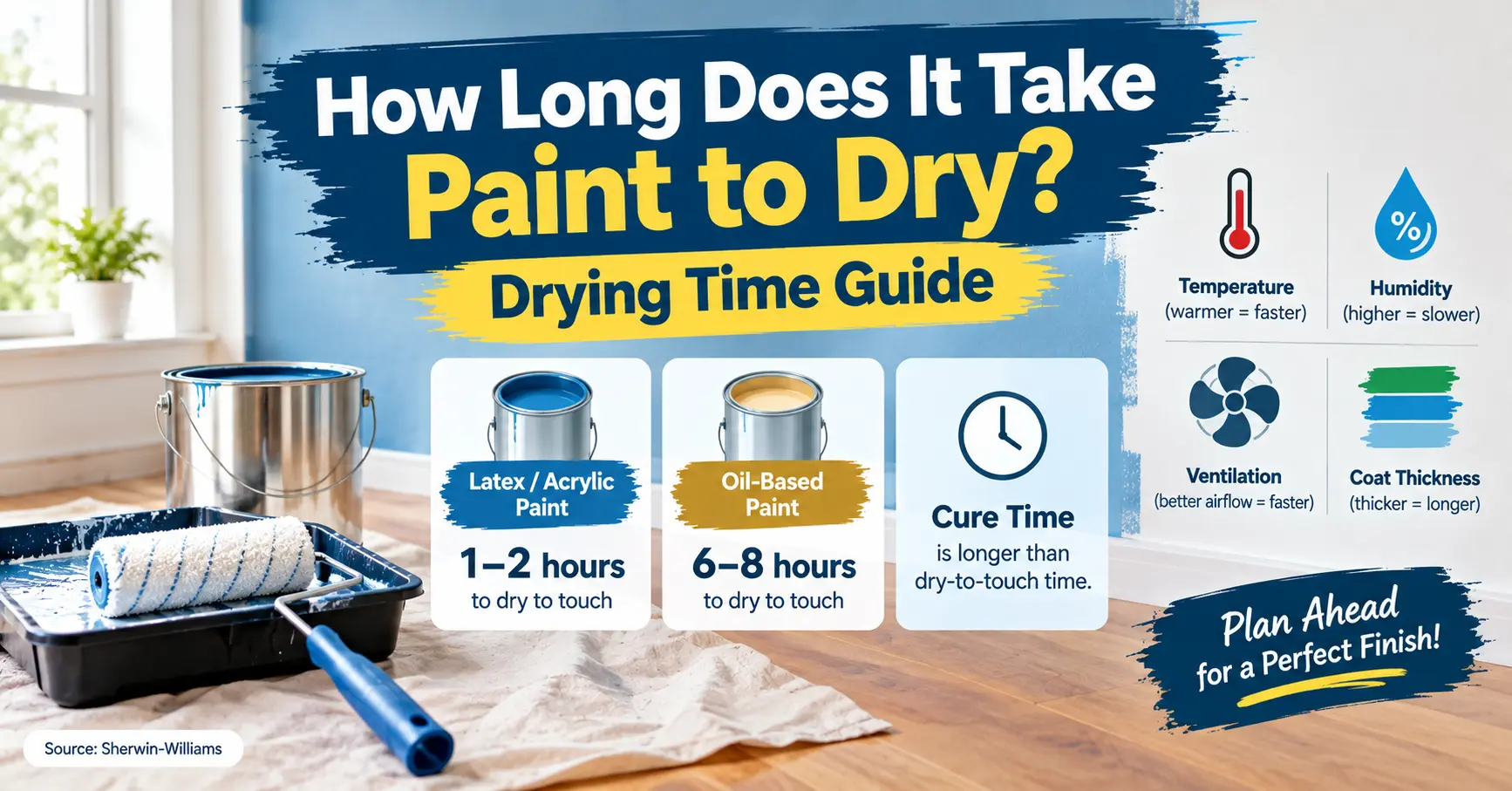
Latex and acrylic paints are the most common choice for interior walls, and for good reason: they dry relatively fast and clean up with water. In typical indoor conditions, a coat of latex wall paint will usually be dry to the touch within one to four hours. That means you can often apply a second coat the same day, generally after waiting about four hours to be safe.
Full curing is a different story. Even though the wall looks finished after a day, latex and acrylic paints typically need two to four weeks to cure completely. During that window, it’s best to avoid scrubbing the surface hard, hanging heavy picture frames that press into the wall, or pushing furniture directly against it. Kitchens and bathrooms painted with latex should also be given extra curing time before regular cleaning, since these rooms tend to see more moisture and contact.
How Long Does Oil-Based Paint Take to Dry?
Oil-based paints behave very differently from their water-based counterparts. They dry more slowly because the solvents they contain evaporate at a slower rate, but many painters still prefer them for trim, doors, and cabinetry because of the smooth, durable finish they leave behind.
Expect oil-based paint to be dry to the touch in about six to eight hours, though humidity and room temperature can stretch that window significantly. Recoating should generally wait a full 24 hours to avoid trapping solvent underneath a new layer, which can cause wrinkling or tackiness. Full cure time for oil-based paint is longer than latex, often taking one to two weeks, and sometimes longer in cooler or more humid environments.
How Long Does Spray Paint Take to Dry?
Spray paint is designed for speed, which makes it popular for small projects, metal surfaces, and touch-up work. A light, properly applied coat of spray paint is often dry to the touch in just fifteen to thirty minutes.
That quick surface dry time can be deceiving, though. If you plan to add a second coat, most spray paints recommend waiting about an hour so the layers bond correctly instead of lifting or clouding. For a fully cured, scratch-resistant finish, it’s safer to give spray-painted items twenty-four hours or more before handling them roughly. Items like furniture or outdoor decor that will see regular contact benefit from waiting even longer, since spray paint applied too thickly in one pass can trap solvent underneath and take considerably longer to harden all the way through.
Factors That Affect How Fast Paint Dries
Paint type sets the baseline, but several environmental factors can speed up or slow down drying time in ways that surprise a lot of people.
Humidity is one of the biggest culprits. Water-based paints in particular rely on evaporation, and high humidity slows that process dramatically, sometimes doubling the expected dry time. Temperature plays a similar role: most paints are formulated to dry best between 50 and 85 degrees Fahrenheit, and painting in a cold garage or an overly hot attic can throw off drying times in either direction. Airflow matters too. A room with poor ventilation traps moisture near the surface, while a gentle cross breeze from an open window or a fan can noticeably shorten drying time.
Coat thickness is another major factor, and it’s one painters control directly. A thin, even coat dries far faster than a thick, heavy one, because there’s simply less material for the moisture or solvent to escape from. Applying paint too thickly in an attempt to save time by skipping a second coat almost always backfires, leading to a surface that feels dry on top while remaining soft and vulnerable underneath.
How to Speed Up Paint Drying Safely
There are several practical ways to help paint dry faster without compromising the final finish. Improving airflow is one of the simplest steps: opening windows, running a fan angled across the room rather than directly at the wet surface, and turning on an exhaust fan in bathrooms or kitchens can all help moisture escape more quickly.
Controlling temperature and humidity also makes a real difference. Running a dehumidifier during and after painting pulls excess moisture out of the air, which is especially useful in damp climates or rainy seasons. If possible, painting during a stretch of mild, dry weather rather than in the middle of summer humidity or winter dampness will naturally cut down on wait times. Finally, applying thin, even coats rather than one thick layer, and choosing a quick-dry formula when time is tight, are two of the most reliable ways to get a project finished faster without sacrificing quality.
Common Mistakes That Slow Down Drying Time
Even careful painters run into the same handful of mistakes that extend drying time unnecessarily. Painting over a surface that wasn’t fully cleaned or dried from a previous coat is one of the most frequent issues, since trapped moisture underneath a new layer has nowhere to go. Applying a second coat too soon is another common error; it can seal in solvent from the first coat and lead to a tacky, uneven finish that takes far longer to fully harden.
Poor ventilation is an easy trap to fall into, especially in smaller rooms like bathrooms or closets where opening a window isn’t always an option. Without some form of airflow, even a well-applied coat can take significantly longer than expected. Lastly, ignoring the manufacturer’s recommended dry times printed on the can is a mistake worth avoiding altogether, since those numbers are based on testing under standard conditions and are usually far more reliable than guesswork.
Conclusion
Paint drying time isn’t a single fixed number, it’s a range shaped by the type of paint used, how thick each coat is applied, and the conditions in the room itself. Latex paints dry fastest and are ready for light use within a day, while oil-based paints and thicker applications demand more patience. Spray paint offers speed for small projects but still benefits from a full day before heavy handling. Understanding the difference between surface drying and true curing is the key to avoiding damage and getting a finish that lasts. With the right conditions and a little patience, most paint projects reward the wait with a smooth, durable result that holds up for years to come.