How Long to Smoke Pork Shoulder: A Simple Guide to Getting It Right
Anyone who has stood in front of a smoker at six in the morning, coffee in hand, wondering whether the How long to smoke pork shoulder sitting in the smoke chamber will be ready by dinner, knows the particular kind of anxiety that comes with low and slow cooking. Unlike a steak or a chicken breast, a pork shoulder does not follow a neat, predictable timeline. It can stall for hours, defy your meat thermometer, and generally test your patience in ways that make you question every decision that led you to buy a twelve-pound cut of meat in the first place.
That uncertainty is exactly why so many people search for guidance on smoking times before they even light the charcoal. They want a rough number to plan around, even if that number ends up shifting once the cook is underway. This guide walks through what actually determines How long to smoke pork shoulder takes to smoke, why the process is so unpredictable, and how to read the signals your meat gives you instead of relying purely on the clock.
What Determines Smoking Time for Pork Shoulder
At its core, smoking a pork shoulder is about slowly breaking down tough connective tissue and fat until it becomes soft enough to shred with a fork. That transformation happens because collagen inside the meat converts into gelatin, but only when the internal temperature stays in a certain range for a long enough stretch. This is fundamentally different from cooking a cut of meat to a target temperature quickly; here, time at temperature matters just as much as the temperature itself.
Most pitmasters plan for somewhere between ninety minutes and two hours of smoking time per pound when the smoker runs at 225 to 250 degrees Fahrenheit. A typical eight-pound shoulder might take twelve to sixteen hours, while a smaller five-pound cut could be done in eight to ten. Those numbers are starting points, not guarantees, because the actual cook time depends on a combination of factors working together rather than any single variable acting alone.
Key Factors That Affect Your Cook Time
The smoker temperature is the most obvious variable, but it is rarely as stable as people assume. Charcoal and wood-fired smokers fluctuate with wind, ambient temperature, and how often the lid gets opened, while pellet smokers tend to hold steadier heat. Even a twenty-degree swing over several hours can add or subtract an hour or more from your total cook time, which is one reason two people using the same recipe on the same size shoulder can finish at noticeably different times.
The size and shape of the shoulder matters just as much. A boneless shoulder tends to cook slightly faster than a bone-in cut of the same weight, since the bone acts as an insulator and slows heat penetration near the center. Thickness plays a role too; a shorter, wider cut exposes more surface area to heat than a long, narrow one, even if the total weight is identical. Then there is the infamous stall, a period usually between 150 and 170 degrees internal temperature where evaporative cooling from moisture on the meat’s surface can hold the temperature flat for two or three hours, sometimes longer, regardless of how hot the smoker runs. Understanding the stall as a normal part of the process, rather than a sign something has gone wrong, saves a lot of unnecessary stress.
How to Plan Your Smoking Schedule
Because so much depends on conditions you cannot fully control, the most reliable approach is to build in generous buffer time rather than aiming to finish at an exact hour. A common strategy among experienced smokers is to start the cook far earlier than seems necessary, then hold the finished meat wrapped in a cooler for an hour or two if it finishes ahead of schedule. Holding rested meat is far less stressful than scrambling to speed up a shoulder that is running behind when guests are already arriving.
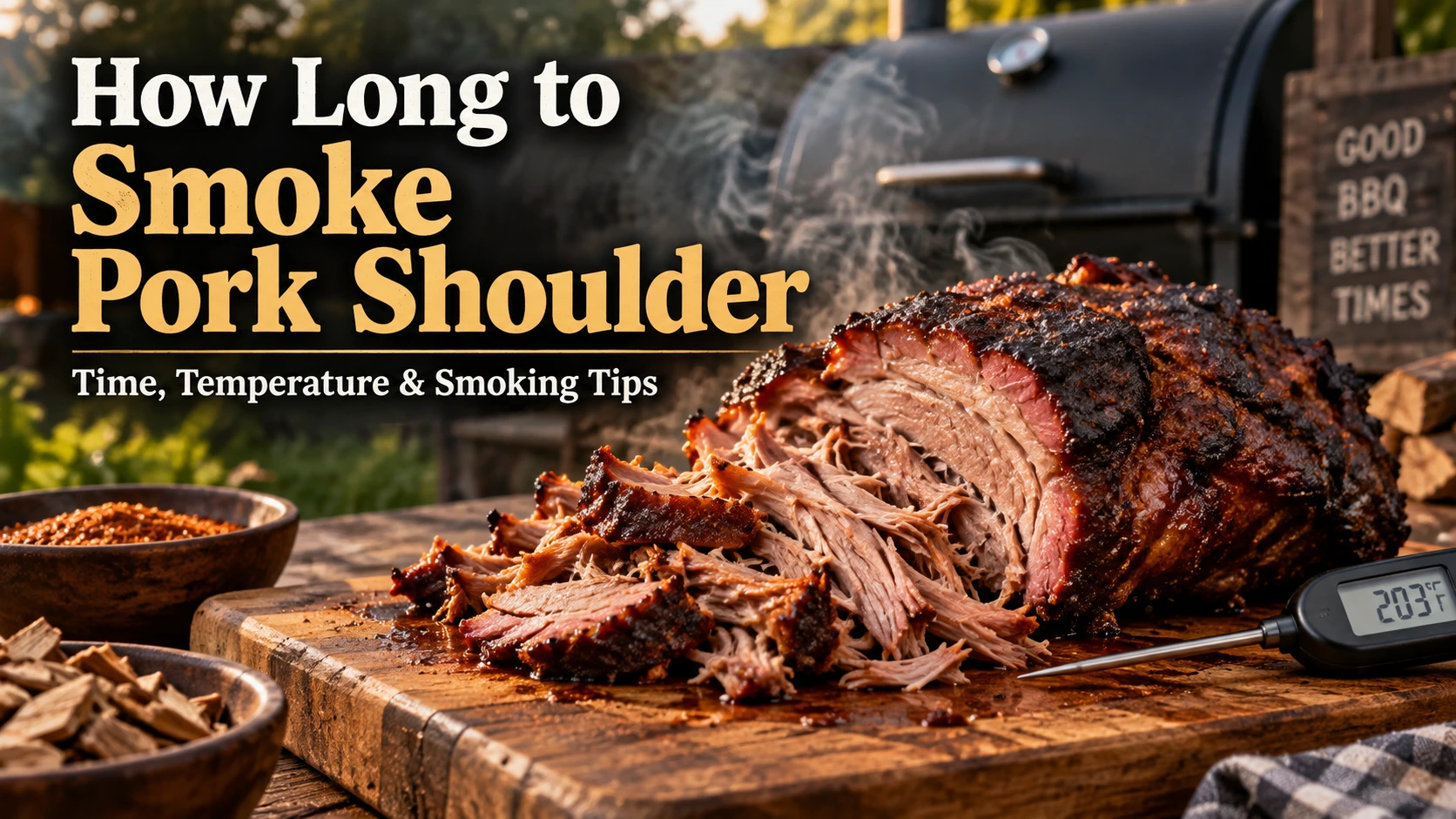
Rather than watching the clock, most experienced cooks watch the meat itself. A reliable instant-read or leave-in probe thermometer placed in the thickest part of the shoulder, away from the bone, gives a far better sense of progress than elapsed hours alone. How long to smoke pork shoulder destined for pulling is typically taken to an internal temperature between 195 and 205 degrees Fahrenheit, the point at which the connective tissue has broken down enough for the meat to pull apart easily. Texture is the real signal to trust: when a probe slides into the thickest section with almost no resistance, similar to pushing a thermometer into softened butter, the shoulder is generally ready, regardless of what the clock says.
Common Mistakes That Throw Off the Timeline
One of the most frequent errors is opening the smoker too often to check on things. Every time the lid comes off, heat escapes and the smoker needs time to recover, which can add up to a meaningful delay over a long cook. It helps to trust the equipment and check in less often than instinct suggests, particularly during the first several hours when the bark is still forming.
Another common misstep is relying solely on cook-time estimates without ever checking internal temperature, which leads to shoulders that are pulled too early and remain tough and difficult to shred. On the opposite end, some cooks panic during the stall and crank the heat dramatically, which can dry out the exterior before the interior has finished breaking down properly. A calmer approach, sometimes called the Texas crutch, involves wrapping the shoulder in foil or butcher paper once it hits the stall to push through that plateau more consistently, though even that technique still requires patience rather than rushing the process entirely.
Factoring Rest Time Into Your Total Timeline
The smoking time itself is only part of the equation; resting the meat afterward is just as important for the final result. Once pulled from the smoker, a pork shoulder benefits from resting for at least thirty minutes, and often much longer, wrapped in foil and towels inside an insulated cooler. This resting period allows juices that were pushed toward the center during cooking to redistribute throughout the meat, and it gives the internal temperature a chance to stabilize before shredding.
Skipping this step, even when the shoulder has technically reached the right internal temperature, often results in meat that seems less juicy and harder to pull cleanly than expected. Building an hour or two of rest time into your overall schedule, on top of the smoking time itself, tends to produce noticeably better results and also gives you welcome flexibility if the cook finishes earlier or later than planned.
Tips for Getting Consistent Results
Investing in a reliable thermometer setup, ideally one that tracks both the smoker’s ambient temperature and the meat’s internal temperature simultaneously, removes much of the guesswork that leads to timing frustration. Keeping a simple log of past cooks, noting the weight of the shoulder, the smoker temperature, and how long each stage actually took, also helps build a more personal sense of how your specific equipment behaves over time, since every smoker has its own quirks.
Maintaining steady airflow and fuel management throughout the cook matters more than most beginners expect, particularly with charcoal or offset smokers where temperature swings are more common. Starting earlier than feels necessary, keeping the lid closed as much as possible, and treating the internal temperature as the true finish line rather than a specific hour on the clock are habits that consistently lead to better, more predictable outcomes across different cuts and different days.
Conclusion
How long to smoke pork shoulder well is less about hitting an exact number of hours and more about understanding the variables at play and responding to what the meat is actually telling you along the way. Smoker temperature, cut size, bone placement, and the unpredictable stall all interact in ways that make rigid timelines unreliable, which is why experienced cooks lean on internal temperature and texture rather than the clock alone. With realistic time expectations, a dependable thermometer, and enough patience to let the process unfold naturally, a consistently tender, pull-apart result becomes far easier to achieve, cook after cook.